
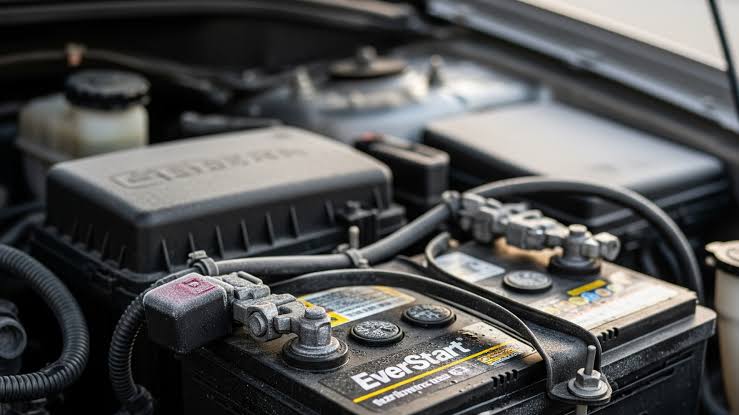

A car battery draining overnight almost always comes down to one of these nine causes. Some are obvious the moment you check, while others take an actual parasitic drain test to catch.
A quick number worth knowing before you start guessing. A parked car normally draws somewhere around 20 to 50 milliamps at rest, and that’s the clock, the alarm system, and various computer modules keeping their memory alive.
Anything meaningfully above that, especially into the 100+ milliamp range, is a real drain worth chasing down.
1. An interior or trunk light left on. The most common cause by far. A door not fully latched, a glovebox light stuck on, or a trunk light that doesn’t switch off can quietly drain a battery overnight without anyone noticing.
The tell here is usually a battery that’s completely dead by morning after just one night, rather than a slow weakening over several days.
2. A faulty alternator diode. When one of the diodes inside an alternator fails, it can allow current to flow backward from the battery even with the engine off and the key out. This is a less obvious cause and usually needs a proper diagnostic check to confirm.
The tell is a drain that persists no matter what’s unplugged or disconnected inside the cabin, since the problem sits at the alternator itself, not in any accessory circuit.
3. A key fob or keyless entry module drawing continuous current. The receiver module in a keyless entry system stays awake listening for the fob’s signal, which draws a small continuous current.
Usually this draw is small enough to be harmless, but a fault in the module or a fob stuck communicating can push that draw high enough to drain a battery overnight.
The tell is a drain that changes noticeably when the fob is moved further from the car or removed entirely.
4. Aftermarket accessories wired incorrectly. Stereo systems, dash cams, alarms, and GPS trackers wired directly to the battery instead of through a switched circuit will draw power even when the car is off.
I install GPS trackers regularly, and a poorly wired one is a genuinely common, avoidable cause of exactly this complaint.
The tell is usually straightforward; the drain drops the moment that specific accessory’s fuse or connection is pulled.
5. A module that won’t fully power down, like the instrument cluster. Some electronic modules occasionally fail to go into sleep mode properly after the car is switched off, staying partially active and drawing current all night instead of powering down.
I diagnosed exactly this on a 2005 Highlander recently, and it wasn’t obvious at first. The car went through three separate checks before the instrument cluster turned out to be the actual source of the drain, and everything else tested normal, and it was only pulling the cluster’s fuse (ECU B) specifically that finally showed the draw disappeared.
The tell, when you find it, is the same as any module-based drain, current drops the instant that specific fuse is pulled, but getting there sometimes takes working through several fuses before landing on the right one, exactly as it did on that Highlander.
6. A relay stuck closed. Relays for the fuel pump, cooling fan, or other components can occasionally stick in the closed position, keeping a circuit powered that should have shut off with the engine. The tell is often an audible click or hum from the relay’s location even with the car fully off.
7. Corroded or loose battery terminals. A weak connection can sometimes cause a battery to drain faster than it should, especially combined with any of the other causes on this list, since resistance at the terminal can interfere with how the battery holds and releases charge.
The tell here isn’t current draw at all, it’s visible white or bluish buildup at the terminals themselves.
8. An old or already weak battery. A battery nearing the end of its life holds less charge overall and self-discharges faster than a healthy one, so what looks like overnight drain can sometimes just be normal aging catching up.
The tell is a battery that’s 3 to 5 years or older and shows a normal parasitic draw reading, meaning nothing is actually pulling current, it’s simply not holding what it used to.
9. A short somewhere in the wiring. Damaged insulation or a pinched wire touching bare metal can create a small constant drain that’s genuinely difficult to find without a proper parasitic drain test, pulling fuses one at a time while monitoring current draw to isolate exactly which circuit is at fault.
The tell is a drain that doesn’t clearly trace to any single accessory or module and often needs the full fuse-by-fuse process below to actually be located.
How to Actually Find It
Guessing from this list rarely finds the real cause on its own. This is the actual process for isolating which of these nine is responsible.
- Confirm there’s really a drain. With the car off and doors closed for at least 20 to 30 minutes so all modules go to sleep, connect a digital multimeter set to DC current (or an amp clamp, which doesn’t require breaking the circuit) in series with the negative battery terminal. A reading meaningfully above the normal 20 to 50 milliamp range confirms a real parasitic drain.
- Pull fuses one at a time, watching the reading after each one. Work through the fuse box systematically, waiting a few seconds after each pull for the reading to settle. The exact moment the draw drops back into the normal range tells you which circuit the drain is on.
- Narrow it down within that circuit. Once you’ve found the fuse, that circuit’s fuse box label or wiring diagram tells you which components share it. If more than one component sits on that circuit, as it did with the Highlander’s cluster, among other things on the same fuse, further isolation may mean disconnecting components individually within that circuit until the specific culprit is confirmed.
- Confirm the fix. After repairing or replacing the actual cause, repeat the current draw test to confirm the reading has returned to the normal range before considering the job done.
For the voltage numbers to check alongside this process, see our guide on what car battery voltage should be.
Conclusion
Most overnight drain cases turn out to be simple, a light left on, an aging battery, or a poorly wired accessory.
But some, like the Highlander’s cluster, take real patience and a proper process to find. When the obvious causes are ruled out, the real answer is almost always found with a proper drain test, not another guess.
Work through the list, rule out the easy ones first, and test for the rest rather than replacing a battery that might not be the actual problem.






Leave a Reply