
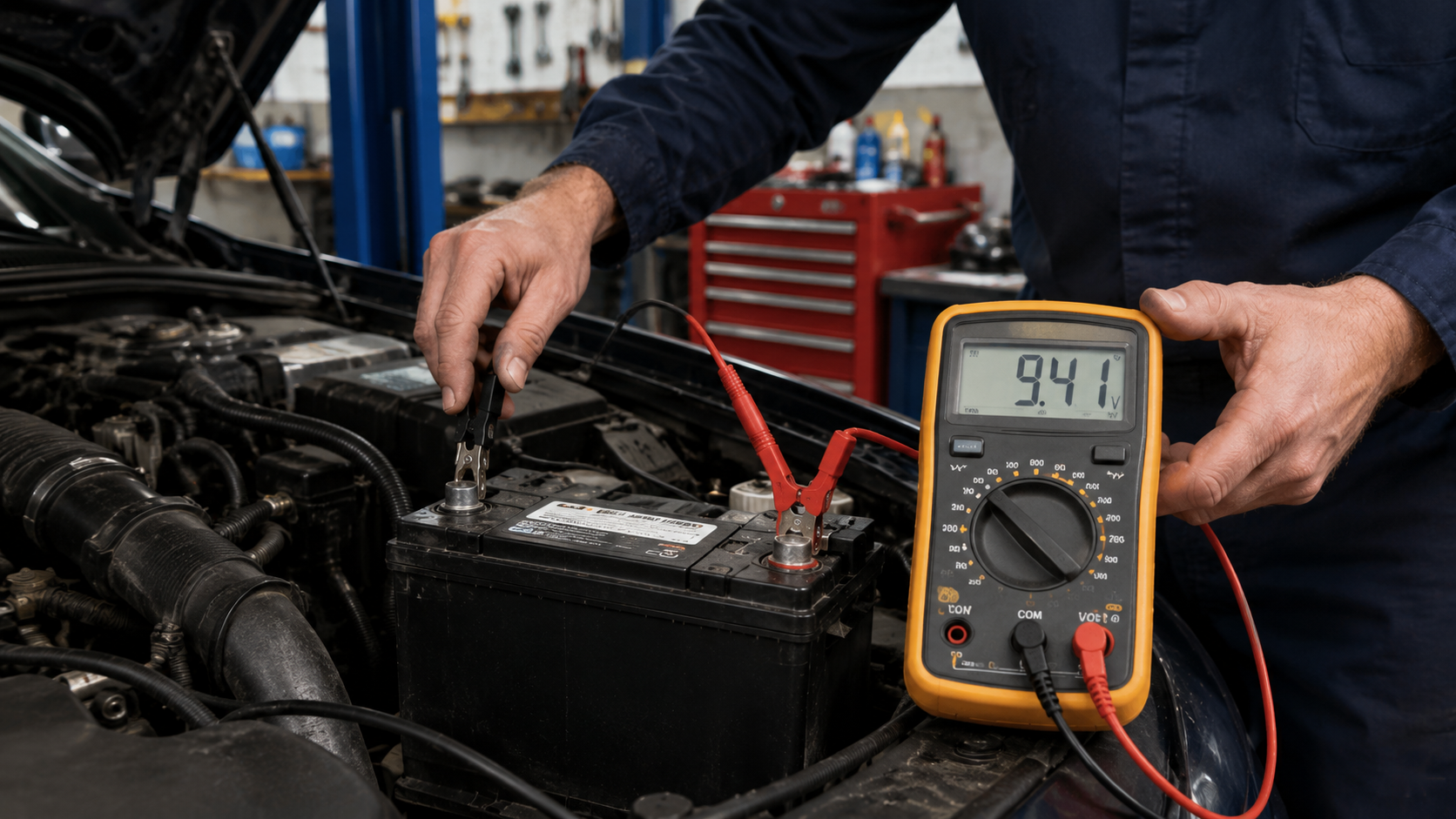

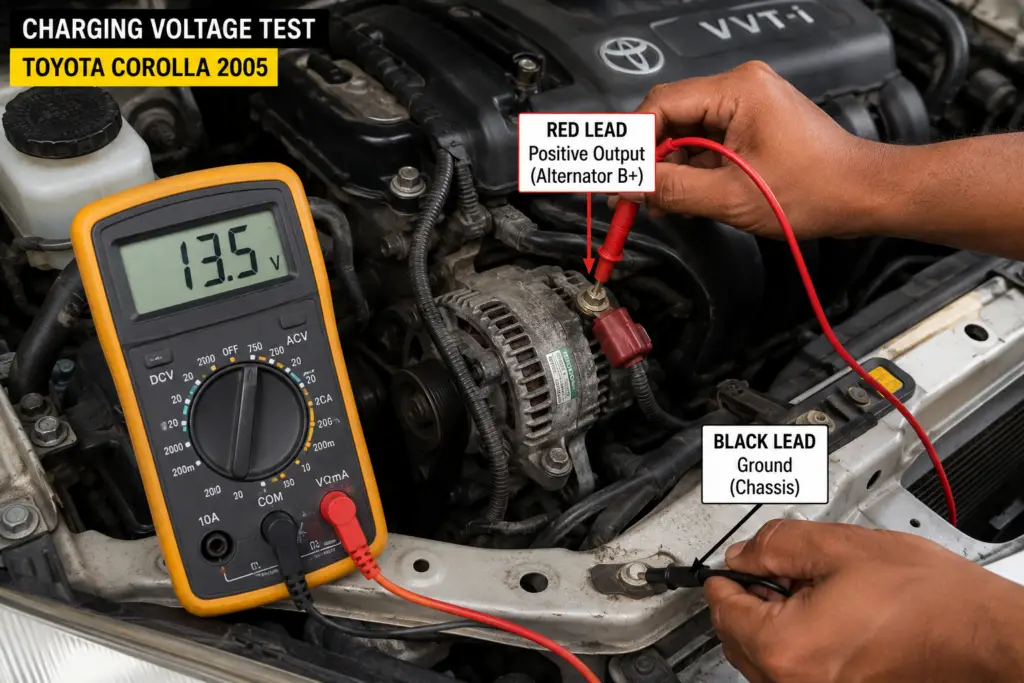
A healthy 12V car battery should read 12.6V or higher at rest (engine off), 13.5V to 14.7V while the engine is running (alternator charging), and shouldn’t drop below roughly 9.6V to 10V during cranking. If your reading falls well outside these ranges, something in the battery, charging system, or connections needs attention.
If you’ve searched this and landed on different numbers on different sites for what should car battery voltage be?. You’re not imagining it. Several sources slightly disagree, and it’s worth understanding why before you assume your battery is fine or failing based on a single number.
The Reference Numbers, By State
| Battery state | Expected voltage | What it means |
|---|---|---|
| Resting (engine off, sat 15-30 min) | 12.6V or higher | Fully charged, healthy |
| Resting | 12.4V | Roughly 75% charged |
| Resting | 12.2V | Roughly 50% charged |
| Resting | Below 12.0V | Discharged, needs charging or testing |
| Cranking (engine turning over) | 9.6V or higher | Acceptable under starter load |
| Cranking | Below 8.5V to 9V | Weak battery or high-resistance connection |
| Running (alternator charging) | 13.5V to 14.7V | Alternator charging normally |
| Running | Above roughly 14.5V to 15.0V | Overcharging, investigate the charging system |
| Running | Close to 12V (barely above resting) | Alternator not charging, a separate issue |
For the full step-by-step guide on testing cranking voltage properly with a multimeter, see our car battery load test guide. This article covers what the numbers should be, and that one covers exactly how to get an accurate reading.
Why Different Sources Give Slightly Different Numbers
Small variation between sources (12.6V vs 12.8V, or a cranking floor of 9.6V vs “around 10V”) mostly comes down to a few real factors, not one source being wrong and another right.
- Temperature: Cold weather genuinely lowers usable voltage and raises the current needed to crank, which shifts the “acceptable” floor slightly.
- Surface charge: A battery tested right after driving can read artificially high for a few minutes before settling to its true resting voltage. This is why resting voltage should be measured after the car has sat for at least 15-30 minutes, not immediately after a drive.
- Battery chemistry and age: AGM, standard flooded lead-acid, and other battery types can have marginally different healthy ranges.
None of this means the numbers are unreliable. It means a single reading in isolation matters less than understanding the state you tested it in.
The Detail Most Guides Skip About Where You Test
Most guides skip something worth knowing. It’s possible to test charging voltage at the battery terminals and see a voltage of 12.6V. Then you test directly at the alternator output and have a reading of 13.7V. Yet the battery still isn’t getting properly charged in practice.
When this happens, the real problem is often in between. A corroded or high-resistance cable running from the alternator to the battery is a common cause. A bad ground connection somewhere in that circuit is another.
In other words, the alternator can be doing its job. The battery terminal reading can look plausible. And a weak link in the wiring can still be quietly preventing the charge from getting through properly.
If your readings look inconsistent between the alternator and the battery, that’s exactly where to check next. Look at the cable and the grounds first, not necessarily the alternator or battery themselves.
When “High” Becomes Overcharging
A running voltage in the 13.5V to 14.7V range is normal. Once readings consistently climb above roughly 14.7V to 15.0V, that’s generally considered overcharging, not a good sign. Overcharging can cook a battery over time, boiling off electrolyte, warping plates, and shortening its life, so a persistently high reading deserves the same attention as a low one, not less.
When you begin to notice abnormal or constant burning in electrical components in the car, check the voltage of the alternator it could be above the standard.
This article is for general informational purposes on what should car battery voltage be?. For a specific vehicle showing unusual readings, a proper diagnostic check is the reliable way to confirm what’s actually happening.
What voltage is a car battery when fully charged?
A fully charged 12V car battery should read 12.6V or higher at rest, with the engine off and the car having sat for at least 15-30 minutes.
What voltage should a car battery be when the engine is running?
With the engine running and the alternator charging normally, voltage should read between roughly 13.5V and 14.7V.
What voltage is too low for a car battery?
Below 12.0V at rest generally indicates a discharged battery. Below roughly 9.6V during cranking, or well under 8.5V, indicates the battery is struggling under load.
What voltage is considered overcharging?
Running voltage consistently above about 14.5V–15.0V is generally considered overcharging and is worth investigating rather than ignoring.
Why does my battery read fine at the terminals but still seem undercharged?
This can happen when the alternator and battery both test normally in isolation, but the cable connecting them or a related ground connection has developed resistance. Checking the cable and grounds between the alternator and battery is the next step when readings don’t add up.









Leave a Reply