


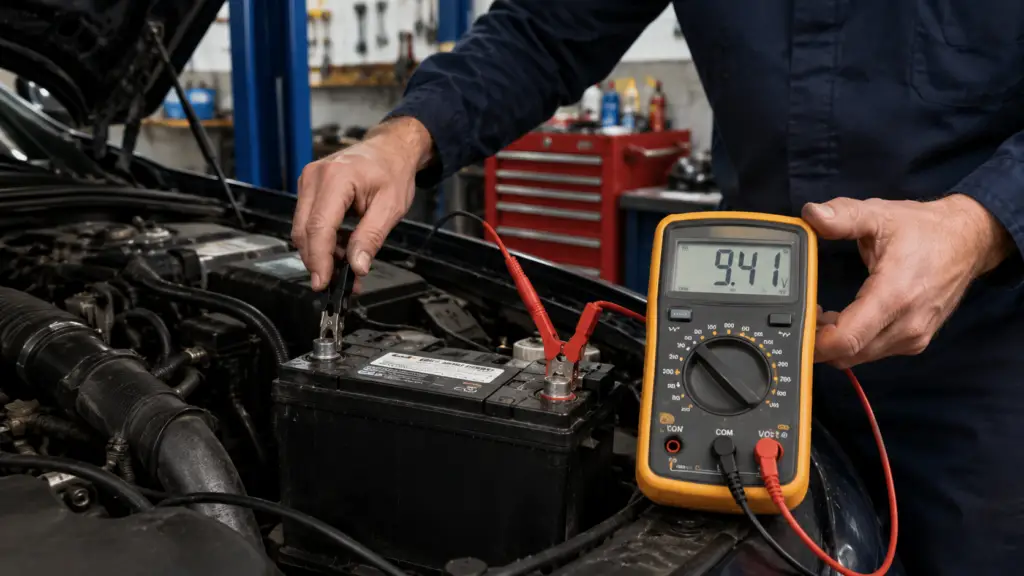
A car battery multimeter can read a perfectly healthy 12.6V sitting still, and the battery still fails the moment you actually turn the key. That’s the gap most battery checks miss. A resting voltage reading only tells you the battery is charged.
It says nothing about whether it can deliver enough current under load to crank the engine. The real test is the cranking voltage reading, taken with a multimeter while the engine is actually turning over.
A healthy battery shouldn’t drop below roughly 9.6V during cranking; if it sags well under that, especially into the 8V range or lower, you’re looking at a battery that’s failing under load even if it “tests fine” at rest.
This guide walks through both tests properly, the resting voltage check and the cranking/load test that actually tells you whether the battery can do its job.
Static Voltage Test vs. Cranking (Load) Test — Why They’re Different
A static voltage test measures the battery with the engine off and everything idle. It’s useful, but it’s a snapshot of stored charge, not capability.
A weak battery can still hold close to 12.6V at rest and then collapse the instant it’s asked to push 150-300+ amps through the starter motor.
The cranking test measures voltage during that demand and the moment the battery is under real electrical load.
This is the number that actually correlates with whether your car will start reliably, especially in the mornings, in cold weather, or after the car has sat for a few days.
If you’ve ever had a battery that seemed “fine” the night before and then struggled to start the next morning, this is almost always the gap between a good resting voltage and a poor cranking voltage.
Step-by-Step: Testing Cranking Voltage With a Multimeter
What you’ll need: a digital multimeter and, ideally, a second person (or a way to see the multimeter display while cranking). Some technicians clip the meter where it’s visible from the driver’s seat.
Safety first: keep hands, tools, and multimeter leads clear of the fan, belts, and pulleys. Set the parking brake and keep the transmission in park or neutral before starting any test involving cranking the engine.
- Check resting voltage first: With the engine off and the car sitting for at least a few minutes (headlights, AC, and accessories off), set your multimeter to DC voltage and connect red to positive and black to negative.
A fully charged battery should read 12.6V or higher. Anywhere from 12.2V to 12.4V suggests a partial charge, and below 12V suggests a battery that’s significantly discharged before you’ve even tested it under load. - Connect the multimeter and keep it in place: Always connect the black (negative) lead to the negative terminal first and then the red (positive) lead to the positive terminal.
Connecting in this order helps prevent sparking. Leave the leads connected to the terminals when you’re about to crank the engine with the meter still attached, so make sure the clamps or probes are secure and won’t slip onto anything else. - Disable the engine from actually starting, if you want a pure cranking-only reading.
Some technicians pull the fuel pump relay or a coil connector so the engine cranks but doesn’t fire because this isolates the cranking demand without the engine load changing things once it starts.
This step is optional, as a normal start also gives you usable reading in the first second or two of cranking, you have to watch closely. - Crank the engine and watch the lowest voltage reached. This is the number that matters. Most digital multimeters update fast enough to catch the dip, but a meter with a “min/max” recording function makes this much easier and more accurate. It captures the lowest point automatically instead of relying on you catching a flicker.
- Read the result against these general benchmarks:
- 9.6V or higher during cranking (at roughly normal ambient temperature): generally acceptable — the battery is delivering adequate current under load.
- 8.5V–9.5V: borderline. The battery may be starting to fail, especially in cold weather, or there may be a connection/cable resistance issue rather than the battery itself.
- Below 8V: a battery struggling this much under load is very likely weak or failing, assuming the starter and cables are confirmed good (see the misdiagnosis section below).
- Check running/charging voltage too while you’re at it. Once the engine starts, the voltage should climb to roughly 13.7V–14.7V, showing the alternator is charging properly. If it stays flat near 12V with the engine running, that’s a charging system issue, not a battery issue, which is a different diagnosis entirely.

Why This Gets Misdiagnosed
The most common mistake made by DIY owners and some shops alike is testing only the resting voltage, seeing a decent number, and concluding “the battery is fine,” then chasing the starter, ignition switch, or wiring instead.
A battery that’s weak, specifically under load, will pass a lazy resting voltage check every time.
The second most common mistake runs the other way, assuming a low cranking voltage always means a bad battery without checking the cable and terminal condition first.
Corroded or loose battery terminals, a worn ground strap, or high-resistance battery cables can cause the same voltage sag under load as a genuinely failing battery.
But the fix is cleaning or replacing a cable, not buying a new battery. Before condemning a battery based on a load test, do a voltage drop test across the battery cables and ground connection while cranking.
A drop of more than about 0.5V across any single connection point under load points to a bad connection, not necessarily a bad battery.
It also helps to be clear on what you’re actually diagnosing. When a battery runs down and won’t start the vehicle, the first question is whether it’s simply drained and needs recharging or whether it’s too weak to hold a charge at all.
These call for different next steps, and a single voltage reading right after a jump-start won’t reliably tell you which one you’re dealing with.
If you get a poor or inconsistent result from a battery you genuinely believe should be fine, don’t take that one reading as final.
Recheck the terminal connections and run the test again to confirm you’re getting an accurate result, rather than acting on a fluke reading.
It’s also worth remembering that not every battery is sitting in plain sight under the hood.
Some vehicles have the battery tucked under a trim panel, in the trunk, or under a seat, so make sure you’ve actually found the real battery and terminals before testing anything.
Car Battery Multimeter tool
This test works with any basic digital multimeter. The kind most DIY owners already own is enough for a usable reading.
Where it gets more precise is with a meter that has a min/max hold function, since catching the exact lowest cranking voltage by eye on a fast-changing display is genuinely difficult.
For a second layer of confirmation beyond the multimeter reading, a scan tool like this Thinkcar Pro can also pull live battery and charging system data on many vehicles, which is useful for cross-checking a borderline result rather than relying on the multimeter alone.
Before this little device became common on every technician’s bench, getting an accurate read on cranking voltage was genuinely difficult, most people were left guessing based on how the engine “felt” turning over.
A multimeter changed that entirely. It’s what makes this whole test possible in the first place.
If you’re serious about working on cars in 2026 and beyond, owning one isn’t optional.
It’s one of the most affordable tools that will consistently save you from misdiagnosing a battery, a cable, or a starter.

When It’s Not the Battery
If cranking voltage is low but the battery itself tests fine when checked directly at the terminals with a proper load tester (not just a multimeter), and voltage drop across the cables and ground is within a normal range, the problem is more likely:
- A failing starter motor drawing excessive current
- A high-resistance connection somewhere in the starting circuit (corroded terminal, damaged cable, bad ground)
- In some cases, a partially seized engine or accessory (alternator, power steering pump) adding unusual resistance to cranking
If you’ve gone through the steps above and the readings don’t clearly point to one component, that’s the point to take it to a technician with a proper load tester and amp clamp, rather than continuing to chase parts without confirming the actual fault, which usually costs more than the original problem.
What is a normal cranking voltage for a car battery?
Generally, 9.6V or higher during cranking is considered acceptable for most vehicles at normal ambient temperature. Readings that consistently drop into the 8V range or lower usually indicate a weak battery or a high-resistance connection in the starting circuit.
Why does my battery read fine at rest but fail to start the car?
A resting voltage test only measures stored charge, not the battery’s ability to deliver current under load. A battery can hold a decent resting voltage and still sag badly the moment the starter draws several hundred amps. which is exactly what a cranking/load test is designed to catch.
Can a bad cable cause a low cranking voltage reading even with a good battery?
Yes. Corroded terminals, a worn ground strap, or damaged battery cables can cause the same low-voltage symptom as a failing battery. A voltage drop test across the cables and ground connection while cranking will show whether the problem is really the battery or just a poor connection.
What voltage should a car battery show when the engine is running?
With the engine running and the alternator charging properly, voltage should typically read between 13.7V and 14.7V. A reading that stays close to resting battery voltage (around 12V) with the engine running points to a charging system problem, not a battery problem.
Do I need a professional load tester, or is a multimeter enough?
A multimeter is enough to get a useful cranking voltage reading, especially one with a min/max function. A dedicated battery load tester or a diagnostic scan tool with live data adds more precision and is worth using to confirm a borderline result before replacing a battery unnecessarily.








Leave a Reply